Why the ALRock Mobile Stands Out
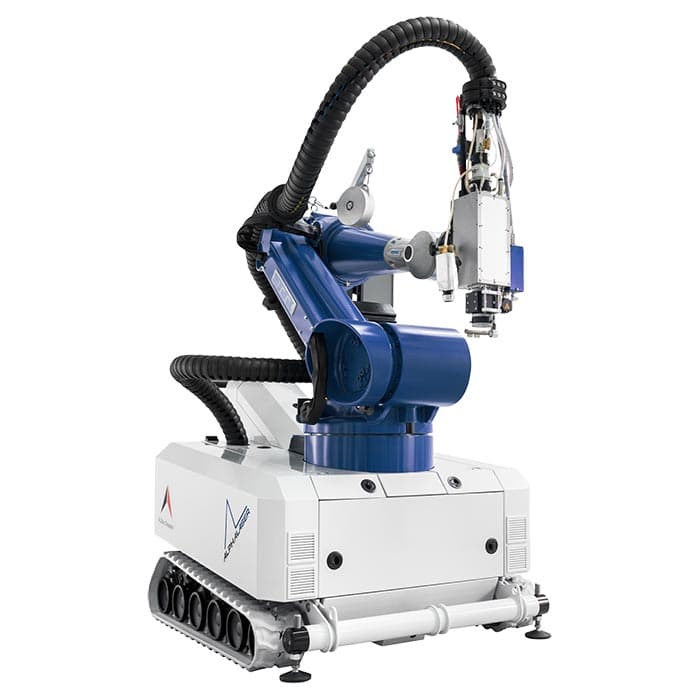
The component to be hardened no longer needs to be dismantled, as the laser can be brought right to the work-piece. The far-reaching robot arm can easily access hard-to-reach places. All that is needed is the laser beam’s free access to the work-piece surface to be hardened.
The area which is to be hardened can be easily programmed using the scanner software: simply select the area that you wish to scan. Then the robot moves the scanner automatically to the marked area over multiple tracks. The result is a real-time 3D model. The operator then simply configures the process-relevant parameters, after which the program is simulated virtually.
The generated and confirmed program is automatically sent to the robot.
The laser beam precisely follows the work-piece contour in free 3D movements. Weld edges, nubs, grain structures, or individual points can be easily hardened this way. There is practically no thermal load on the surrounding area, which means that distortion is kept to a minimum. The heat flux within the component leads to self-quenching.
- On-site hardening — saves time and cost by eliminating the need to dismantle components.
- Accurate process planning — real-time 3D modelling and virtual simulation ensure optimal results.
- Selective treatment — hardens only the required areas, preserving the integrity of surrounding material.
- Reduced thermal stress — self-quenching effect minimises distortion and maintains dimensional accuracy.
- Versatile and efficient — ideal for large tools, molds, or machine components requiring localised hardening.